Friday, 3 July 2015

Loggery

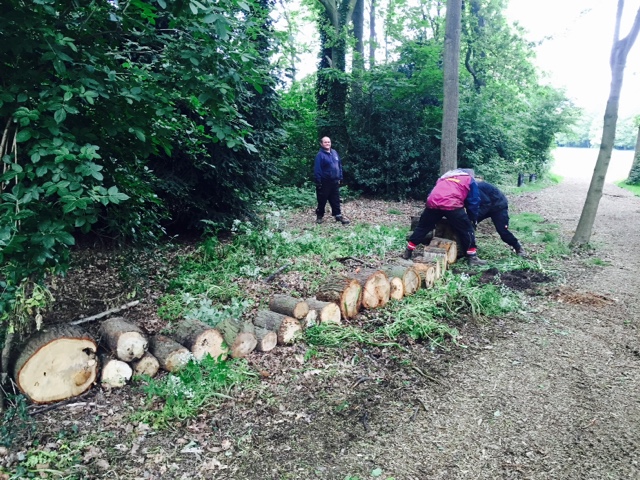
Following the winter of tree work & woodland management in-between the 15th and 16th holes, there remained a large amount of felled timber. The plan was to recycle this timber where possible in other areas identified on the course. The smaller pieces and branches were already recycled through our own wood chipper and spread on pathways to improve presentation. The remaining timber logs were cut into manageable sizes and transported over a period of time to the rear of the 9th green in the wooded area between the 9th and 10th holes. 

The timber logs were then placed along the edge of the path creating a barrier/wall over a number of weeks on days when course management activities needed to be kept to minimum. The wall was completed on the 4th attempt and stretches the complete length of the path. 


Not only does this mark a creative feature as you walk through the woodland to the next tee, it also acts as a great habitat for wildlife to populate. As it naturally breaks down, millions of insects and other forms of wildlife and fungi will benefit from it, creating even more rich pickings for other wildlife like birds to feed on.

Thursday, 2 July 2015

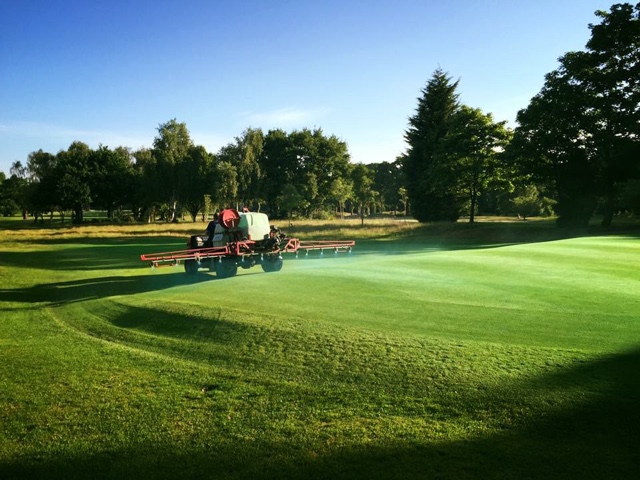
Disease...... A New Independent Sprayer and Product Applications

Most people only associate grass diseases with winter, most notably fusarium (Microdochium Nivale). Fusarium can still however develop well into the spring and summer if conditions are suitable. Fusarium however is just one of many grass diseases that can develop throughout the year. One disease that Langley Park also suffers from more than others is Anthracnose. A disease that develops when the grass plant is under stress during the summer period when frequent mowing at low summer heights of cuts combine with other stress related contributing factors. 

Along with fusarium, anthracnose and the potential risk of other disease outbreaks, many products have now been developed to combat against them, by preventing the diseases opportunity from developing in the outset. 

Far more products are applied through a sprayer than ever before. As well as applying fungicides in a curative capacity, we also apply fungicides now in a preventative capacity. Fungicide products are now produced with many different active ingredients and physical and biochemical modes of action. Contacts, systemics, preventatives and curatives are the four main modes of action. Different fungicides also only work efficiently during particular times of the year. So selecting the right fungicide to spray at the right time is key.

There are five stages of fungal development, Spore Germination, Penetration, Mycelial Growth, Blistering and then Sporulation. During this period of fungal development, choosing a preventative, curative, or eradicant fungicide is challenging. The challenge is to know when to apply a preventative, without wastefully applying where there was little or no disease risk - which is where the combination of good local knowledge and disease forecasting can prove so effective.

This might help explain why the sprayer is used and seen far more often than it used to be a decade ago.


Not only is there a vast selection of different fungicides with different modes of action, there are also many other products such as seaweeds and other biostimulant products. These products contain plant growth substances able to enhance the health and vigour of turf-grass, which also helps combat against disease. They also help to supplement nutritional programs, and are just as invaluable in maintaining turf quality throughout the year as fungicides and foliar feeds. Include other products such as wetting agents, which break down surface tension to allow water through the soil profile and you can soon see why applying products and the frequency is very important. 

It is on this basis that we are now purchasing a new independent sprayer. Our current sprayer is 8 years old and sits on a cushman utility vehicle that is now 11 years old. New legislation coming into effect also now requires that spraying machinery has to pass an annual MOT. This is to determine that the equipment is working efficiently and applying products correctly and safely, both for the benefit of the general public, golfers and the sprayer operator.


For the management of fine sports turf surfaces, a sprayer is now arguably the most important piece of equipment in any machinery fleet.

Congratulations

Congratulations to Assistant Greenkeeper Wayne Aris on completing a two year course for the NVQ Level 3 Qualification in Amenity Sports Turf Management.

Thursday, 26 March 2015

Protecting the Good Progress

With the current schedule of work undertaken on the course recently, combined with the recent poor weather, damage limitation leading up to the main golfing season is paramount.


Therefore protecting areas from unnecessary traffic is unfortunately necessary including restrictions on trolley use until, or if, conditions are favourable.


Tuesday, 24 February 2015

Tree Work and Woodland Management Completed this Winter & why?


Work Completed                                               Reason

Thinning of the woodlands between the 15th green
and 16th hole.
To help assist and improve the performance of the
15th green, collar and apron, in conjunction with the collar drainage.

Removal of the large oak on the 16th carry protruding
from the woodland edge on the left of the carry.

To open the entry to the 16th fairway from the tee
and to prevent future problems occurring with the increasing growth and size of this
tree in this particular area.

Removal of trees along the left-side of the
13th carry from the tee.
To allow for full use of the tee width and to prevent
future problems occurring with the increasing growth and size of trees
in this particular area.

Pruning of limbs along the right-side of the
17th carry from the tee.
To allow for full use of the tee width and to prevent
future risks of damage to machinery managing the grass in this particular area. 

Removal of the large oak beside the
9th tee. 
To help improve the performance of the 9th tee and
to help reduce the need to waste water and over irrigate the tee.

Removal of the large oak beside the 8th green.

To help improve the performance of the 8th green and
to help reduce the need to waste water and over irrigate the green.
A root barrier was installed originally to avoid removal, however this
has proved to be unsuccessful.

 Removal of trees and pruning along the
right-side of the 9th carry.
To allow for full use of the tee width and to prevent
future problems occurring with the increasing  growth and size
of trees in this particular area.

Removal of trees behind the 8th tee.
To help improve the performance of the 8th & 10th tees,
and to prevent future problems occurring with the increasing growth
and size of trees in this particular area.
(Shrubs were planted on the fence line in advance last year).

Removal of trees behind the 2nd tee.

To help improve the performance of the wettest tee on the
course, which continuously sits in the shade.

Removal of trees left-side of the 4th tee.

To allow for full use of the tee width and to prevent future
problems occurring with the increasing growth and size of trees in
this particular area.


Trees removed vary in shape and size. Some trees have also been removed due to their misshapen form of growth created due to growing under the canopy of larger trees. removing these smaller misshapen trees benefits the larger mature specimens which remain.

Some other trees and limbs have also been removed for safety reasons, either from evidence of decay (4th) or to prune out dead wood in the tree canopy (17th).

Evergreen shrubs like Holly have been left untouched in random places because they make safe, year-round retreats where birds and small mammals can hide from predators and remain protected from inclement weather. These shrubs also produce berries which attracts wildlife to readily eat. A diverse type and size of cover plants is useful to have. This is also why many Hawthorn trees have been pruned aggressively in recent years to develop into better cover and understory shrubbery.
Thursday, 19 February 2015

Heather Re-Generation Project

To improve aesthetics around the course, whilst balancing between ecology and reducing maintenance costs, it has been a plan for some time to develop some areas that were identified for Heather establishment restoration. Another reason for attempting this project was the other most noticeable component of heathland areas, gorse, which is already well established at LPGC and spreading in areas already left unattended. The original plan started many years ago by allowing areas to grow wild and removing growth, effectively removing the possibility of nutrients from cuttings returning to the soil. As Heather doesn't colonise well in nutrient rich environments, this practice was followed for many years.

Heather Brashing (topped Heather) was purchased from Hankley Common Golf Club in Surrey. These Brashing contain seed heads which will hopefully regenerate naturally. This phase which is known as the pioneer phase can take 5-6 years, from seedling development and establishment until the plant has developed into a fully formed bush.

The areas identified were firstly stripped of turf exposing bare soil.


The areas were then dug over loosening the surface creating an almost perfect seed bed. 


The Brashing which contain millions of Heather seeds were then added covering the soil, which was then turned over again mixing the Brashing and soil together.


After the mixing the areas were flattened and compacted.

Unfortunately it is now a case of being patient and waiting to see signs of germination and the growth of healthy Heather plants. There is no guarantee that this will be successful, however without trying we will never know. 

Until further notice these areas will be compulsory GUR.


Tuesday, 17 February 2015

New Practice Nets Installation and Construction

The immediate impact of course presentation upon arrival to Langley Park was the main driver for the improvements to the practice nets. An increase in size to add a third bay was also a much needed requirement.

The first step was to remove the existing framework and remove the outdated and unattractive base. 


After the framework was dismantled, the base which was constructed of rubber mats laying over concrete slabs on sharp sand had to be removed. A partial area which was also covered using another type of matting was also discarded.


A concrete area that's was laid to one side also had to be removed so the new base would be of a consistent construction.


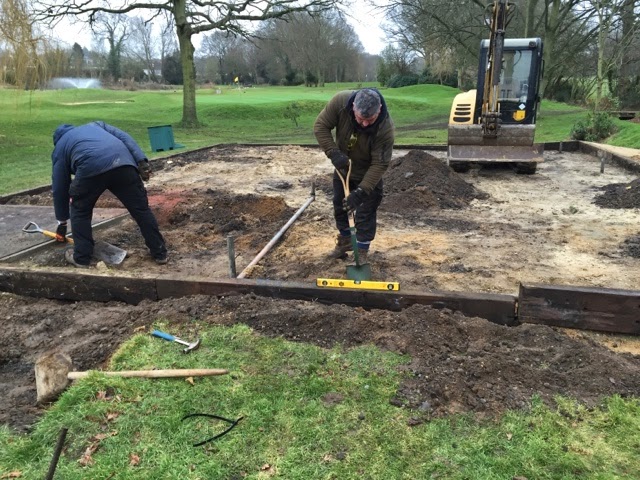
After the area was cleared of all materials, including the sharp sand, a new edge constructed of railway sleepers was added to the existing edge to complete and increase the base size.


Following the installing of a new edge, the outside edges where filled and levelled with rootzone to give support for the filling of the base with type 1 aggregate and a crushed stone topping finish.


While the rootzone was being laid, the footing legs for the additional third bay were positioned and cemented in place.


To allow for a secure fixing of the new matting. A border inside the sleeper surround was attached 20mm beneath the sleeper top.


Having now completed the edge and additional footings, the in-filling with type 1 and crushed stone commenced.


Now the construction of a new base was complete, a new matting surface supplied by Huxley Golf was laid.


After the matting was laid the framework could again be constructed over the new base.


The old structure was 3.5m high. The new structure was reduced in height to 3m and the other dimensions remained the same as the original.


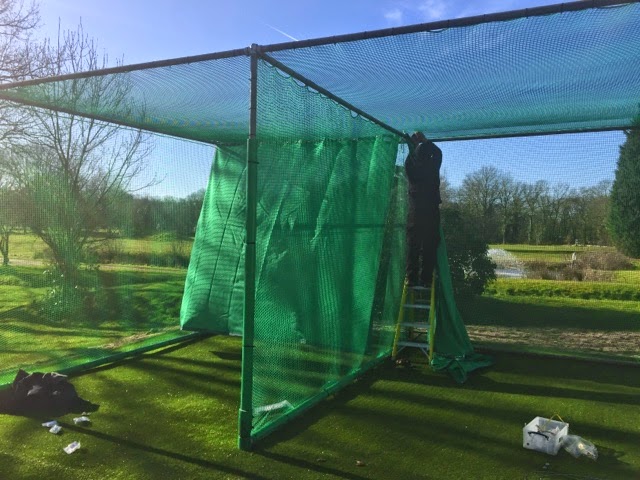
Once the framework was erected and secured in place, a new netting surround was attached.


PVC coated foam padding was attached to the lower poles and uprights for additional safety.


Once the netting and padding was in place the fitting of baffle nets fixed to tensioning wires completed the project.


New mats were also laid for use in the new nets


And finally the New Practice Nets were completed and ready for use.


Special thanks and appreciation goes to Will & Grant from Huxley Golf and Club Members Paul & Perry Hanifan for their help, guidance, and assistance before and during the construction of the New Practice Nets.